Showing posts with label Ancient Greece. Show all posts

Saturday, 15 October 2011

Acient Greece in contemporary movies

Clash of the Titans!

What I found interesting was how aesthetically pleasing everything was in the movie


Friday, 14 October 2011

Ancient Greek Embroidery

Here is a little embroidery fun I was having, I took this feathery floral detail from the picture of an “Embroidered Fragment from Kertch” (Greek Dress by E.B. Abrahams) the pattern of which I tried to complete on my sketchbook and explored it through different embroidery techniques, some that I knew, and some that were new to me.

These floral designs are said to be the regular type of decoration.

According to Abrahams the “designs so commonly used for the decoration of pottery were employed also in textile arts” this “is proved by some of the fragments found at Kertch. Quite considerable remains were found of a piece of woollen material elaborately embroidered with a large floral design [seen left] the main motiveof which is a graceful palmette, ffrom the base of which spring spirals terminating in heart-shaped leaves and flowers. The design is executed in gold and green on a violet ground.”

Sunday, 9 October 2011

Christos Costarellos

Christos Costarellos
"My creative process forms a bridge that connects elements from the past, making them relevant to the present as they project ideas for the future." Christos Costarellos

    The fashion house of Christos Costarellos was launched in the Greek market in 1998. His first atelier in the center of Athens, worked with an exclusive clientele who deeply appreciated the designer's charisma in fine tailoring, finishing details and special couture techniques. Soon enough, the Christos Costarellos collections were interpreted as feminine elegance, created with dedicated craftsmanship and infused with an air of ethereal dreams. By the year 2000 his production line was enriched with 2 new ateliers, which provided the flow for the collections' development and the unique creations sur mesure. An infinite creative force, constant research and the unique blend of innovative cuts with traditional moulage techniques, has been the signature of Christos Costarellos' Nouvelle Couture. In 2005 he joined the collective attempt of the Hellenic Fashion Designer's Association, in the launch of the Athens Fashion Week. His fashion shows gained great reviews and Christos Costarellos dignified presence, reinforced the Greek fashion scene with the quality of its' production and its' special creative techniques. Today the House of Christos Costarellos includes a Head Office, an extensive line of Ateliers for the house's Fashion and Bridal collections and a local and international Showroom in Athens and Paris. A worldwide distribution network expands in more than 20 selling points around the globe : Greece and France in Europe and Kuwait, Lebanon, Dubai, Abu Dhabi, Saudi Arabia, Bahrain in the Middle East.
    Christos Costarellos is a Greek designer with an innate talent for delicate feminine creations. He was born in Dusseldorf, Germany and was introduced to the fashion world at an early age, as his parents were both working in the fashion industry. He studied fashion design at Dimitrelis School of Fashion in Greece and then theater costume design at the London College of Fashion, England. In 1998 he launches his personal line and within the next 12 years the House of Christos Costarellos is created and established in the Greek and international market. Forever dedicated to the craftsmanship of moulage and couture techniques, he blends his love for color with unique bias cuts in his distinct creations of Nouvelle Couture. Inspired by the spirit of the ancient Greek philosophy, he infuses a breath of fresh air into his creations, thus creating movement and flow. Two fundamental elements that express the designer's eternal quest for knowledge, evolution and inspiration.


The designs of Costarellos are breathtaking! The lightness and feminine grace of all his designs is intriguing. I could see a beautiful, reserved royal woman wearing this, but not the crazed Maenads... however it is truly this type of lightness that I was looking for. Like the airiness of bird-bones...


My selection from Christos Costarellos' 2011-2012 Autumn/Winter Collection


My selection from Christos Costarellos' Autumn-Winter 2010-2011 Collection


My selection from Christos Costarellos' Bridal 2010 Collection

Saturday, 1 October 2011

Notes on the Greeks

As with all eras of History... 
Different time periods of Greece:
  • Stone Age: c.a. 6000-3000 B.C.
  • Copper-Stone Age: c.a. 3000-2800 B.C.
  • Bronze Age: c.a. 2800-1500 B.C.
  • Homeric, Heroic, Late Minoan Age: c.a. 1400-1100 B.C. 
    • Mycenean: c.a. 1300-1000 B.C.
  • Dorian, Dark, Iron Age: c.a. 1200-800 B.C.
  • The Archaic Age: c.a. 800-500 B.C.
  • The Classical Period: c.a. 500-404 B.C.
    • Ionic Revolt against Persian tyrants appointed by the Persian king: c.a. 499-494 B.C.
    • Golden Age: c.a. 480-400 B.C.
  • Hellenistic Period: c.a. 323-146 B.C.


"The time period around 1400 B.C. was an era where Mycenae, the traditional home of Agamemnon, brother of Menelaus and leader of the Greek warriors in Troy, dominated the mainland, and his island of Crete assumed the political and militaric status of master of the eastern Mediterranean. A golden age of splendor arouse during this period, as shown by excavations of the royal graves at Mycenae, and the cultural and religious traditions of the eminent classical Greece began to take form. This is the Homeric, or Herioc, Age - also called Mycenaean, or Late Minoan -for the culture and values of the latter part of this period are those permanently embodied in the Homeric poems, the Iliad and the Odyssey. The fall of this age is often credited with the Dorian Invasion which is believed to have happened around 1100 B.C., and which came to be the conclusive death blow to the Minoan civilization." from Homer's Greece

For a good bibliography on Greek Costume we can look at Mark Zimmerman's forum.

Dionysus- Satyr/Pan, Nymph, Maenad, Thiasos- an explanation of these terms, and a collection of research materials, and indeed more disturbing phallic images, it is unfortunately impossible to escape them.
Dionysus- The Bacchants (or, The Bacchae) by Euripides- another collection of research materials, quotes and images relevant to Euripides' The Bacchae.

Some more written research, although I know that visual research is prompted I am one of those type that need to do reading research, in a more academic manner. I want to be able to know about the time period, way of life, thinking, rules... of the time period before I feel comfortable to "butt in" to the play.

How do you deal with this? If anyone has any good advice, please share. As I often find myself filling sketchbooks with merely writing and less images than what might be expected (it is also true that I do not like high printing costs, so I much rather sketch and copy out images by hand, which naturally is time consuming, yet more useful as it naturally resutls in a more thorough observation).

More to come later!

Friday, 30 September 2011

Dionysian Imagery in the Fifth Century

Great findings must be shared of Dionysian depictions on Ancient Greek vases. It must be noted that while researching there are too many phallic representations for my tastes.
Carpenter, Thomas H. Dionysian Imagery in the Fifth-Century Athens. Oxford: Clarendon, 1997.

This image of a Bacchae is captivating, it looks like a sweet representation of the oneness with Nature that the Bacchants could reach trough their Bacchic release. It is of a "mid-fifth century amphora in Brussels a nymph wearing an ivy wreath and animal skin and holding a snake and thyrsos looks down at a fawn that jumps up toward her like e pet dog." p.115 On some vases however the nymphs are shown dancing with torn halves of fawns.

The nymph resists the approach of a satyr.
"[...] nymphs in red-figures scenes (as opposed to those on black-figure vases) are often hostile to the erotic advances of satyrs, and they often use their thyrsoi to defend themselves." p.116

Dionysus and his companions

"a naked child holding a kantharos and vine branch stands on the lap of a bearded man seated on a chair. A woman with stylized flowers stands behind him, a woman holding a small himation stands in front. The seated man wears a wreath of pointed leaves (laurel?) and holds a thyrsos. The child wears an ivy wreath.
These figures have frequently been mis-identified as Dionysos and Oinopion, but they are almost certainly intended to be Zeus and the infant Dionysos. Only the thyrsos raises doubt. The child has the attributes appropriate to the young Dionysos..."
Dionysus portrayed as he tears apart a fawn. "Depictions of the madness of Dionysos appear earlier [before 5th century] are [...] linked with Thrace. On a late archaic stamnos in London, the god dances a mad dance with the halves of a rent goat in either hand. He has an ivy wreath on his head and a leopard skin tied at his throat over a chiton. On his feet he wears Thracian boots. [...] In fact, the imagery links him with neither drunkenness nor ecstasy. The scene is not an existential statement but rather a narrative account of the madness sent by Hera. The teraing of an animal in two becomes a symbol of the ultimate stage of this madness and is used to show the same madness inflicted by the god on others." p.38

A "Dionysian procession", "back-flung head is introduced on Attic vases to indicate song, not ecstasy" p. 83.
Sometimes the nymph figures resist and defend themselves from the advances of the satyrs; however on some vases they are depicted as unresisting, emphasizing how the Bacchic ecstatic state takes over the minds of women and men.

Dionysus with his satyr companions

A Winged Fury with a wreath of snakes on her hand and arms.


More to come later!

Tuesday, 27 September 2011

The Exotic Mass

The Phrygians lived on the land we now call Turkey, it might be supposed that they had originally been from the same 'mother tribe' as the Greeks. Phrygia later became part of the Persian Empire.

They worshipped a 'Great Mother', 'Mountain Mother', or Goddess called Cybele, their worship f her was similar to that  of the Diponysiac worship: "a primal nature goddess worshipped with orgiastic rites in the mountains of central and western Anatolia"
It is interesting that some myhts consider her as initially being a hermaphrodite:
The Birth of Kybele Pausanias, Description of Greece 7. 17. 8 (trans. Jones) (Greek travelogue C2nd A.D.) :
"The local [Phrygian] legend about him [Attis] being this. Zeus [or rather the Phrygian sky-god], it is said, let fall in his sleep seed upon the ground, which in course of time sent up a Daimon, with two sexual organs, male and female. They call the daimon Agdistis [Kybele, Cybele]. But the gods, fearing Agdistis, cut off the male organ. There grew up from it an almond-tree with its fruit ripe, and a daughter of the river Saggarios (Sangarius), they say, took the fruit and laid it in her bosom, when it at once disappeared, but she was with child. A boy [Attis] was born."
And even more connection can be found between the Phrygian Cybele and the Greek Dionysos, it is believed that she cared for the baby Dionysos after  Hermes saved him from the anger of Hera.:
"The Phrygian goddess Kybele was the mother of Sabazios (the Phrygian equivalent of Dionysos). The Greeks adapted this tradition by describing Mother Rhea as the nurse and mentor of Dionysos. The Orgia (Orgiastic Cult) of Dionysos-Sabazios was derived from that of the Phrygian Meter Theon."

Pseudo-Apollodorus, Bibliotheca 3. 33 (trans. Aldrich) (Greek mythographer C2nd A.D.) :
"He [Dionysos in his madness driven wanderings] went to Kybela (Cybele) in Phrygia. There he was purified by Rhea and taught the mystic rites of initiation, after which he received from her his gear [presumably the thyrsos and panther-drawn chariot] and set out eagerly through Thrake [to instruct men in his orgiastic cult]."


Cybele, Goddess of Fertility, a 1993 sculpture by Mihail Chemiakin, New York.


I found these two texts (in which Dionysus and Cybele are mentioned) very nice, as they show the caring and fun-loving nature of these two deities.
"Nonnus, Dionysiaca 14. 1 ff :
"[Rheia-Kybele gathers an army for the young god Dionysos at her palace in Phrygia for a campaign against the Indians:] Then swiftshoe Rheia haltered the hairy necks of her lions beside their highland manger. She lifted her windfaring foot to run with the breezes, and paddled with her shoes through the airy spaces. So like a wing or a thought she traversed the firmament to south, to north, to west, to the turning-place of dawn, gathering the divine battalions for Lyaios: one all-comprehending summons was sounded for trees and for rivers, one call for Neiades (Naiads) and Hadryades, the troops of the forest. All the divine generations heard the summons of Kybele (Cybele), and they came together from all sides. From high heaven to the Lydian land Rheia passed aloft with unerring foot, and returning lifted again the mystic torch in the night, warming the air a second time with Mygdonian [Lydian] fire."
[N.B. She summons a variety of rustic divinities and creatures including the Kabeiroi, the Daktyloi (Dactyls), the Telkhines, Pholos and Kheiron, the Kyklopes (Cyclopes), Panes, Kentauroi (Centaurs), Nymphai.]

Nonnus, Dionysiaca 14. 247 ff :
"As soon as Dionysos had donned the well-wrought golden gear of war in the Korybantian courtyard, he left the peaceful precincts of danceloving Rheia and went past Meionia: the warriors with the hillranging Bakkhantes (Bacchantes) hastened to meet the lord of the vine. The drivers of wheeled wagons carried shoots of the new plant of Bakkhos (Bacchus). Many lines of mules went by, with jars of the viney nectar packed on their backs; slow asses had loads of purple rugs and manycoloured fawnskins on their patient backs. Winedrinkers besides carried silver mixingbowls with golden cups, the furniture of the feast. The Korybantes (Corybantes) were busy about the bright manger of the panthers, passing the yokestraps over their necks, and entrusted their lions to ivybound harness when they had fastened this threatening bit in their mouths.""


About her "orgiastic cult it is said that it "dominated the central and north-western districts of Asia Minor, and was introduced into Greece via the island of Samothrake and the Boiotian town of Thebes."


Vatican Museums' Statue of Cybele - Goddess of Fertility


All mythical text from Cybele: Phrygian Mother of the Gods.


I was considering to put the Chorus into Phrygian dress:
Phrygians. Nouveau Larousse Illustre 1894 edition.

Monday, 26 September 2011

Bacchic research

"Even amid bacchic celebrations, the woman who is truly virtuous will not be corrupted." Euripides

Timeline: Ancient Greece 1000 B.C.- 1 A.D.


Women in Classical Greece:

"Women of various ages also took part in specific religious festivals, some of which even included men—the Panathenaia in honor of the goddess Athena, the Eleusinian Mysteries that honored Demeter and Persephone, and the Anthesteria sacred to Dionysos."
Oinochoe-chous (jug) depicting women perfuming clothes, ca. 420-410 B.C,
"The shape of the vase facilitates the association of the scene with the Anthesteria, a three-day festival held in January/February to celebrate the new wine with the special inclusion of young children, an epiphany of Dionysos."

"Despite the extreme social restraint on women in classical antiquity, it is interesting that they had a number of powerful female goddesses of the type that were never available to Christian women. Demeter was able to retrieve her daughter Persephone, Artemis could send a fatal arrow, and Athena had the ability to resist marriage and motherhood, and to provide advice to respected Greek heroes. Aphrodite, Hera, Hestia, and Hekate were also powerful goddesses, intensely honored and greatly admired by women and men alike."

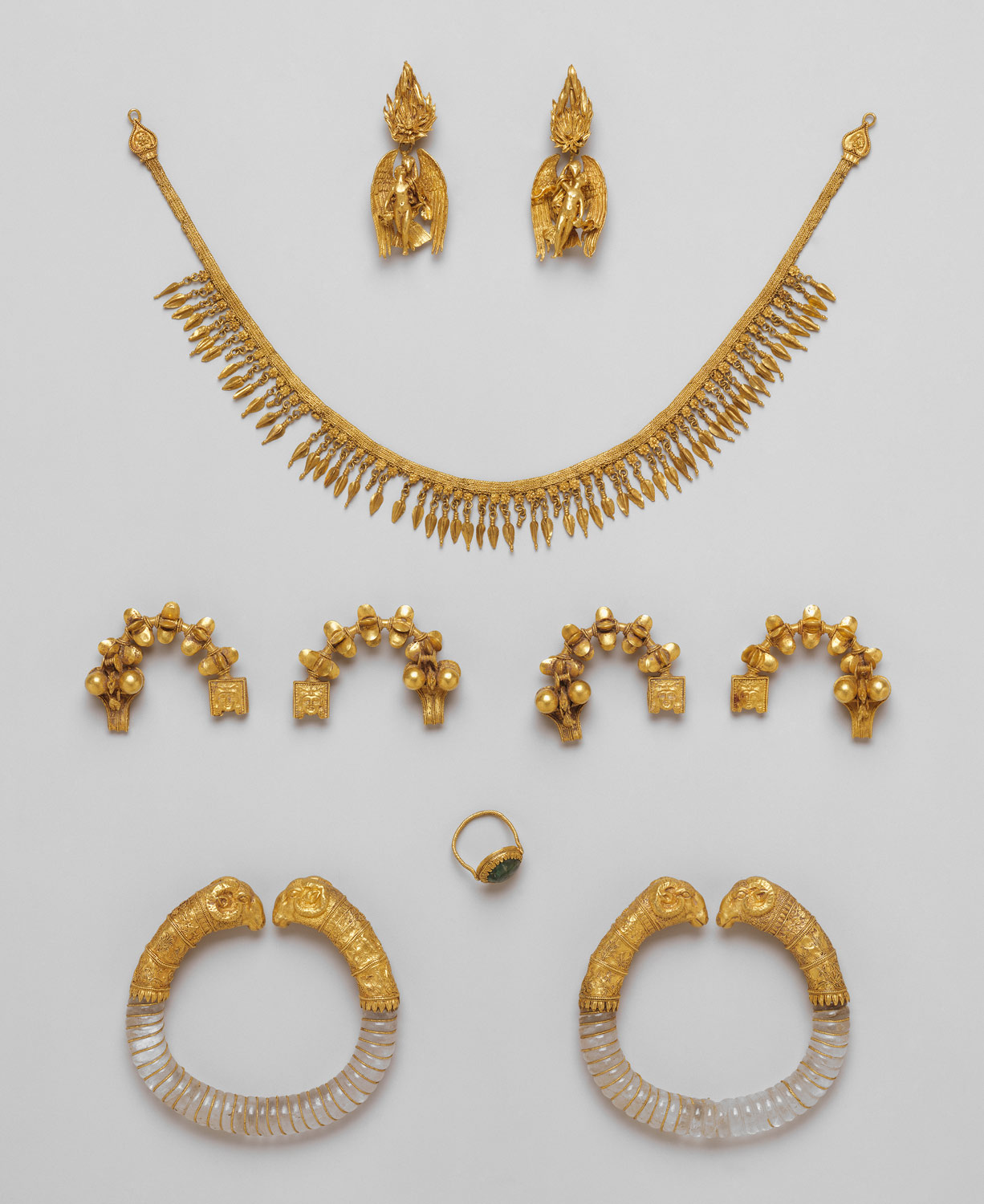
A bit later in date but this Ganymede jewelry is stunning
Gold, rock crystal, and emerald ca. 330-300 B.C.


Death, Burial, and the Afterlife in Ancient Greece:

"The Greeks believed that at the moment of death the psyche, or spirit of the dead, left the body as a little breath or puff of wind. The deceased was then prepared for burial according to the time-honored rituals. Ancient literary sources emphasize the necessity of a proper burial and refer to the omission of burial rites as an insult to human dignity (Iliad, 23.71). Relatives of the deceased, primarily women, conducted the elaborate burial rituals that were customarily of three parts: the prothesis(laying out of the body), the ekphora (funeral procession), and the interment of the body or cremated remains of the deceased."

And it is of course the representation of the Bacchae/Maenads that is the most interesting in the play, as they are strong female characters becoming aware of their ability of self-empowerement.

Fashion Timeline

And now my timid-self might shuffle off to the library.


P.S.: Here is my costume plot for David Greig's version