Showing posts with label The Bacchai. Show all posts

Thursday, 13 October 2011

The Perfect pair

Teiresias and Kadmos

Comical old men, each typical, competing over who might be older.
Kadmos acting as if he believes, but still very traditional. I feel he is very much like the tragic character King Lear. What is a good parent?
King Lear on stage

Greek Pattern from fashion-era.com

Teiresias dealing in strange affairs, selling charms from the mystic Asia Minor. That is why I want to include a Persian pattern here.

It is actually quite interesting how these are all very geometric patterns, whereas the Greek have more ivy-like fluid spirals. And it is, in fact, Pentheus that I would imagine as a more geometric character.

Saturday, 1 October 2011

Notes on the Greeks

As with all eras of History... 
Different time periods of Greece:
  • Stone Age: c.a. 6000-3000 B.C.
  • Copper-Stone Age: c.a. 3000-2800 B.C.
  • Bronze Age: c.a. 2800-1500 B.C.
  • Homeric, Heroic, Late Minoan Age: c.a. 1400-1100 B.C. 
    • Mycenean: c.a. 1300-1000 B.C.
  • Dorian, Dark, Iron Age: c.a. 1200-800 B.C.
  • The Archaic Age: c.a. 800-500 B.C.
  • The Classical Period: c.a. 500-404 B.C.
    • Ionic Revolt against Persian tyrants appointed by the Persian king: c.a. 499-494 B.C.
    • Golden Age: c.a. 480-400 B.C.
  • Hellenistic Period: c.a. 323-146 B.C.


"The time period around 1400 B.C. was an era where Mycenae, the traditional home of Agamemnon, brother of Menelaus and leader of the Greek warriors in Troy, dominated the mainland, and his island of Crete assumed the political and militaric status of master of the eastern Mediterranean. A golden age of splendor arouse during this period, as shown by excavations of the royal graves at Mycenae, and the cultural and religious traditions of the eminent classical Greece began to take form. This is the Homeric, or Herioc, Age - also called Mycenaean, or Late Minoan -for the culture and values of the latter part of this period are those permanently embodied in the Homeric poems, the Iliad and the Odyssey. The fall of this age is often credited with the Dorian Invasion which is believed to have happened around 1100 B.C., and which came to be the conclusive death blow to the Minoan civilization." from Homer's Greece

For a good bibliography on Greek Costume we can look at Mark Zimmerman's forum.

Dionysus- Satyr/Pan, Nymph, Maenad, Thiasos- an explanation of these terms, and a collection of research materials, and indeed more disturbing phallic images, it is unfortunately impossible to escape them.
Dionysus- The Bacchants (or, The Bacchae) by Euripides- another collection of research materials, quotes and images relevant to Euripides' The Bacchae.

Some more written research, although I know that visual research is prompted I am one of those type that need to do reading research, in a more academic manner. I want to be able to know about the time period, way of life, thinking, rules... of the time period before I feel comfortable to "butt in" to the play.

How do you deal with this? If anyone has any good advice, please share. As I often find myself filling sketchbooks with merely writing and less images than what might be expected (it is also true that I do not like high printing costs, so I much rather sketch and copy out images by hand, which naturally is time consuming, yet more useful as it naturally resutls in a more thorough observation).

More to come later!

Friday, 30 September 2011

Dionysian Imagery in the Fifth Century

Great findings must be shared of Dionysian depictions on Ancient Greek vases. It must be noted that while researching there are too many phallic representations for my tastes.
Carpenter, Thomas H. Dionysian Imagery in the Fifth-Century Athens. Oxford: Clarendon, 1997.

This image of a Bacchae is captivating, it looks like a sweet representation of the oneness with Nature that the Bacchants could reach trough their Bacchic release. It is of a "mid-fifth century amphora in Brussels a nymph wearing an ivy wreath and animal skin and holding a snake and thyrsos looks down at a fawn that jumps up toward her like e pet dog." p.115 On some vases however the nymphs are shown dancing with torn halves of fawns.

The nymph resists the approach of a satyr.
"[...] nymphs in red-figures scenes (as opposed to those on black-figure vases) are often hostile to the erotic advances of satyrs, and they often use their thyrsoi to defend themselves." p.116

Dionysus and his companions

"a naked child holding a kantharos and vine branch stands on the lap of a bearded man seated on a chair. A woman with stylized flowers stands behind him, a woman holding a small himation stands in front. The seated man wears a wreath of pointed leaves (laurel?) and holds a thyrsos. The child wears an ivy wreath.
These figures have frequently been mis-identified as Dionysos and Oinopion, but they are almost certainly intended to be Zeus and the infant Dionysos. Only the thyrsos raises doubt. The child has the attributes appropriate to the young Dionysos..."
Dionysus portrayed as he tears apart a fawn. "Depictions of the madness of Dionysos appear earlier [before 5th century] are [...] linked with Thrace. On a late archaic stamnos in London, the god dances a mad dance with the halves of a rent goat in either hand. He has an ivy wreath on his head and a leopard skin tied at his throat over a chiton. On his feet he wears Thracian boots. [...] In fact, the imagery links him with neither drunkenness nor ecstasy. The scene is not an existential statement but rather a narrative account of the madness sent by Hera. The teraing of an animal in two becomes a symbol of the ultimate stage of this madness and is used to show the same madness inflicted by the god on others." p.38

A "Dionysian procession", "back-flung head is introduced on Attic vases to indicate song, not ecstasy" p. 83.
Sometimes the nymph figures resist and defend themselves from the advances of the satyrs; however on some vases they are depicted as unresisting, emphasizing how the Bacchic ecstatic state takes over the minds of women and men.

Dionysus with his satyr companions

A Winged Fury with a wreath of snakes on her hand and arms.


More to come later!

Monday, 26 September 2011

Bacchic research

"Even amid bacchic celebrations, the woman who is truly virtuous will not be corrupted." Euripides

Timeline: Ancient Greece 1000 B.C.- 1 A.D.


Women in Classical Greece:

"Women of various ages also took part in specific religious festivals, some of which even included men—the Panathenaia in honor of the goddess Athena, the Eleusinian Mysteries that honored Demeter and Persephone, and the Anthesteria sacred to Dionysos."
Oinochoe-chous (jug) depicting women perfuming clothes, ca. 420-410 B.C,
"The shape of the vase facilitates the association of the scene with the Anthesteria, a three-day festival held in January/February to celebrate the new wine with the special inclusion of young children, an epiphany of Dionysos."

"Despite the extreme social restraint on women in classical antiquity, it is interesting that they had a number of powerful female goddesses of the type that were never available to Christian women. Demeter was able to retrieve her daughter Persephone, Artemis could send a fatal arrow, and Athena had the ability to resist marriage and motherhood, and to provide advice to respected Greek heroes. Aphrodite, Hera, Hestia, and Hekate were also powerful goddesses, intensely honored and greatly admired by women and men alike."

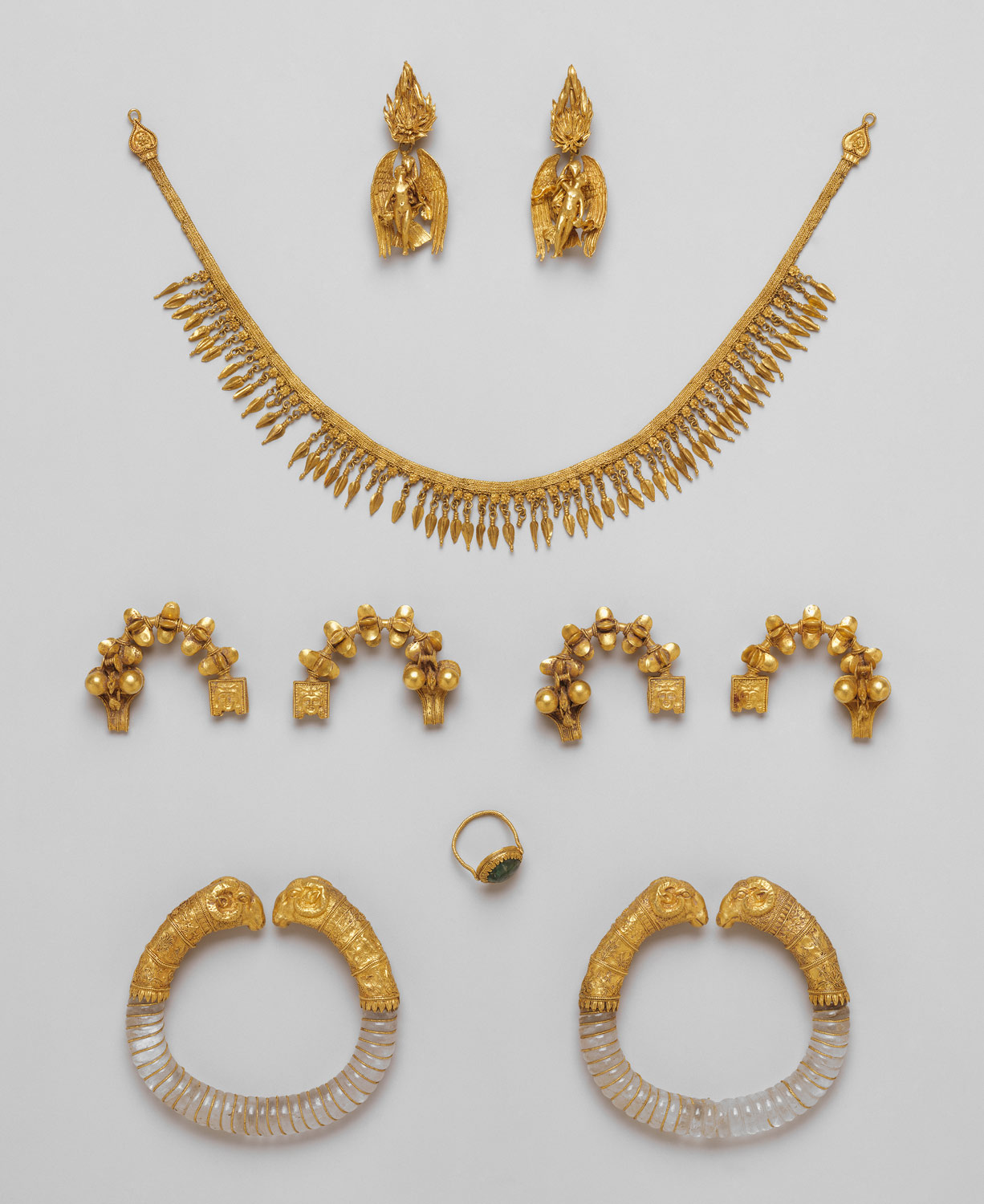
A bit later in date but this Ganymede jewelry is stunning
Gold, rock crystal, and emerald ca. 330-300 B.C.


Death, Burial, and the Afterlife in Ancient Greece:

"The Greeks believed that at the moment of death the psyche, or spirit of the dead, left the body as a little breath or puff of wind. The deceased was then prepared for burial according to the time-honored rituals. Ancient literary sources emphasize the necessity of a proper burial and refer to the omission of burial rites as an insult to human dignity (Iliad, 23.71). Relatives of the deceased, primarily women, conducted the elaborate burial rituals that were customarily of three parts: the prothesis(laying out of the body), the ekphora (funeral procession), and the interment of the body or cremated remains of the deceased."

And it is of course the representation of the Bacchae/Maenads that is the most interesting in the play, as they are strong female characters becoming aware of their ability of self-empowerement.

Fashion Timeline

And now my timid-self might shuffle off to the library.


P.S.: Here is my costume plot for David Greig's version

Tuesday, 20 September 2011

Long live the... Queen...

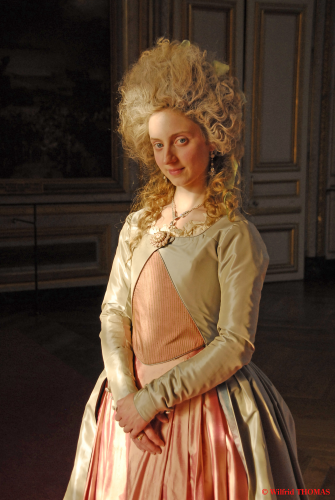
The strange fit of the costumes seen in the upcoming French movie Les Adieus a la Reine are very much noteworthy. I have to post a picture after reading Demode's blog, the most interesting one I found, dear reader, was this:


I cannot quite decide whether if this lady is trying to be pregnant, or terribly modest and ashamed of her own body, thus resorting to misshapen-ness, with her high neckline.
I am however very interested to see what this movie will be like, wondering what the overall effect of the vivid colours (greens) and strange fitting costume will be. I suppose it is very easy to get away with such designs, as most viewers won't be too picky about historical accuracy. It is after all the overall image, mood, atmosphere that will leave an impact in the viewer.


Les Adieux a la Reine is directed by Benoit Jacquot, and I msut admit I have not found information about who the costume designer is.
There is also a behind the scenes interview.

Le us give permission to that queen to drink some wine!
Today we got our first project for our second year at colleg: The Bacchai! It will be qonderful to explore the theatre of Ancient Greece,where better to start anything drama-related than there?

And now, my dearest reader, off to bed for my timid-self, as it is getting late.
More to come later!