Abundant decadence was the first thing I thought of when I looked at Dimtris Dassios' Fall-Winter 2012 collection.Here is a selection I made, pictures from CatwalkMag.
I want to contrast the Royal Maenads with the Minor Asia Bacchants and the poor Woman of Thebes who join the following.
These women would be able to copy the dress-style, the jewellery and the ornaments of the original Bacchae but substituting it with more expensive materials.
A selection from Dassios' jewellery, accessory, and garment collections from his website, it is even called jewel art, a self-explicative name that mirrors the fashion house's talent with jewellery.
Dimitris Dassios uses very structured textures, with a sense of floral organics and hint of tribalesque.
Showing posts with label Maenads. Show all posts
Showing posts with label Maenads. Show all posts
Saturday, 8 October 2011

Monday, 26 September 2011
Bacchic research
"Even amid bacchic celebrations, the woman who is truly virtuous will not be corrupted." Euripides
Timeline: Ancient Greece 1000 B.C.- 1 A.D.

Women in Classical Greece:
"Women of various ages also took part in specific religious festivals, some of which even included men—the Panathenaia in honor of the goddess Athena, the Eleusinian Mysteries that honored Demeter and Persephone, and the Anthesteria sacred to Dionysos."
"Despite the extreme social restraint on women in classical antiquity, it is interesting that they had a number of powerful female goddesses of the type that were never available to Christian women. Demeter was able to retrieve her daughter Persephone, Artemis could send a fatal arrow, and Athena had the ability to resist marriage and motherhood, and to provide advice to respected Greek heroes. Aphrodite, Hera, Hestia, and Hekate were also powerful goddesses, intensely honored and greatly admired by women and men alike."
A bit later in date but this Ganymede jewelry is stunning
Death, Burial, and the Afterlife in Ancient Greece:
"The Greeks believed that at the moment of death the psyche, or spirit of the dead, left the body as a little breath or puff of wind. The deceased was then prepared for burial according to the time-honored rituals. Ancient literary sources emphasize the necessity of a proper burial and refer to the omission of burial rites as an insult to human dignity (Iliad, 23.71). Relatives of the deceased, primarily women, conducted the elaborate burial rituals that were customarily of three parts: the prothesis(laying out of the body), the ekphora (funeral procession), and the interment of the body or cremated remains of the deceased."
And it is of course the representation of the Bacchae/Maenads that is the most interesting in the play, as they are strong female characters becoming aware of their ability of self-empowerement.
Fashion Timeline
And now my timid-self might shuffle off to the library.
 P.S.: Here is my costume plot for David Greig's version
Timeline: Ancient Greece 1000 B.C.- 1 A.D.

Women in Classical Greece:
"Women of various ages also took part in specific religious festivals, some of which even included men—the Panathenaia in honor of the goddess Athena, the Eleusinian Mysteries that honored Demeter and Persephone, and the Anthesteria sacred to Dionysos."
 |
| Oinochoe-chous (jug) depicting women perfuming clothes, ca. 420-410 B.C, |
"The shape of the vase facilitates the association of the scene with the Anthesteria, a three-day festival held in January/February to celebrate the new wine with the special inclusion of young children, an epiphany of Dionysos."
"Despite the extreme social restraint on women in classical antiquity, it is interesting that they had a number of powerful female goddesses of the type that were never available to Christian women. Demeter was able to retrieve her daughter Persephone, Artemis could send a fatal arrow, and Athena had the ability to resist marriage and motherhood, and to provide advice to respected Greek heroes. Aphrodite, Hera, Hestia, and Hekate were also powerful goddesses, intensely honored and greatly admired by women and men alike."
A bit later in date but this Ganymede jewelry is stunning
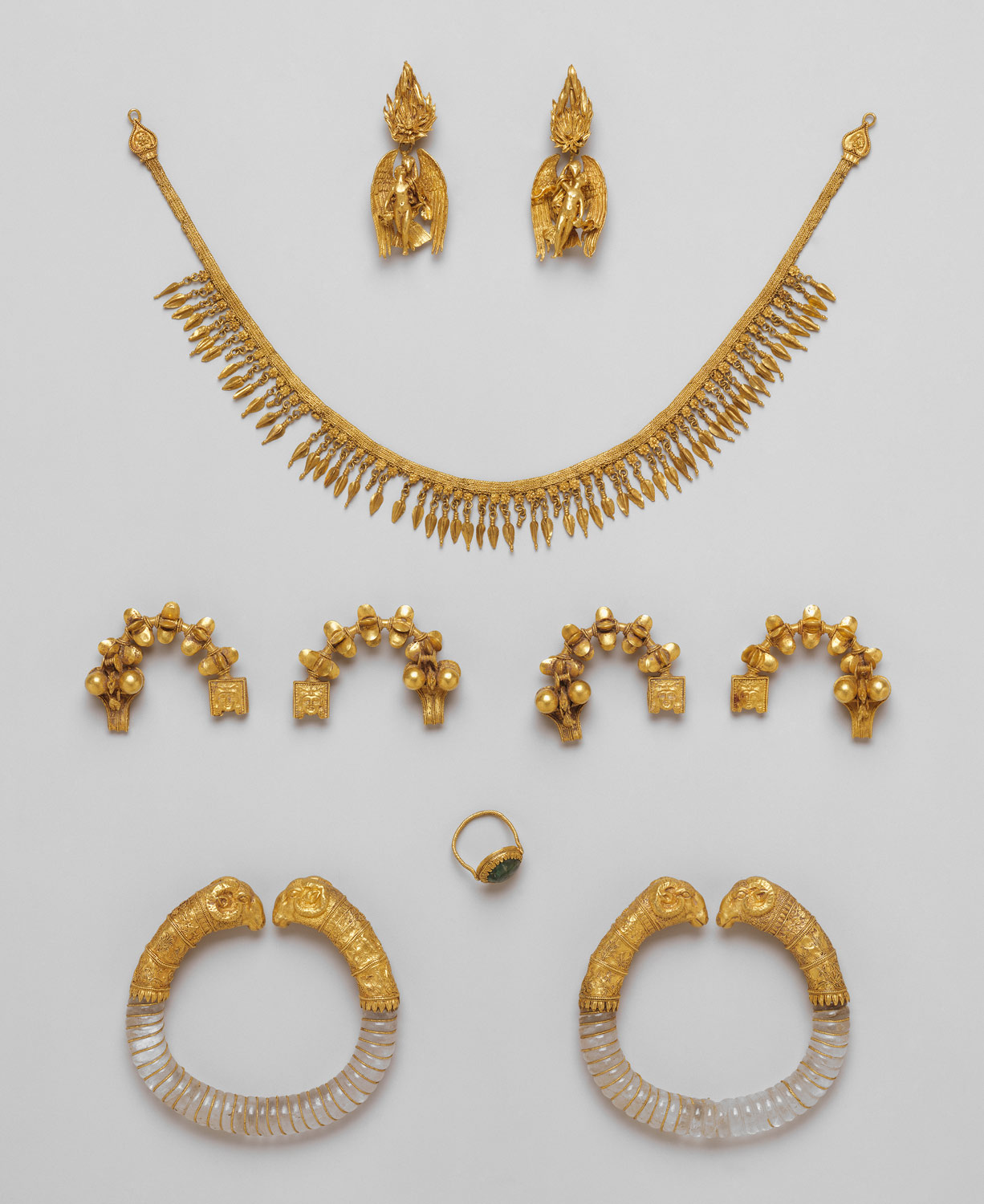 |
| Gold, rock crystal, and emerald ca. 330-300 B.C. |
Death, Burial, and the Afterlife in Ancient Greece:
"The Greeks believed that at the moment of death the psyche, or spirit of the dead, left the body as a little breath or puff of wind. The deceased was then prepared for burial according to the time-honored rituals. Ancient literary sources emphasize the necessity of a proper burial and refer to the omission of burial rites as an insult to human dignity (Iliad, 23.71). Relatives of the deceased, primarily women, conducted the elaborate burial rituals that were customarily of three parts: the prothesis(laying out of the body), the ekphora (funeral procession), and the interment of the body or cremated remains of the deceased."
And it is of course the representation of the Bacchae/Maenads that is the most interesting in the play, as they are strong female characters becoming aware of their ability of self-empowerement.
Fashion Timeline
And now my timid-self might shuffle off to the library.

Subscribe to:
Posts (Atom)