A year-long course of mixed media wonders and fantasies by willowing involving many amazing artists!
Sunday, 25 September 2011
Tuesday, 20 September 2011
Long live the... Queen...
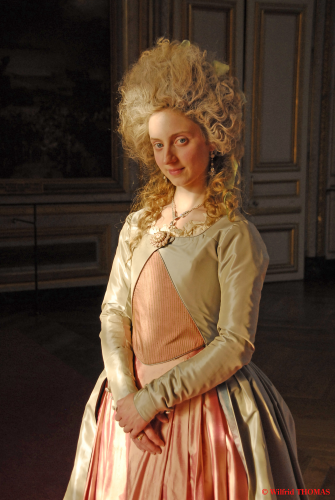
The strange fit of the costumes seen in the upcoming French movie Les Adieus a la Reine are very much noteworthy. I have to post a picture after reading Demode's blog, the most interesting one I found, dear reader, was this:
I cannot quite decide whether if this lady is trying to be pregnant, or terribly modest and ashamed of her own body, thus resorting to misshapen-ness, with her high neckline.
I am however very interested to see what this movie will be like, wondering what the overall effect of the vivid colours (greens) and strange fitting costume will be. I suppose it is very easy to get away with such designs, as most viewers won't be too picky about historical accuracy. It is after all the overall image, mood, atmosphere that will leave an impact in the viewer.
Les Adieux a la Reine is directed by Benoit Jacquot, and I msut admit I have not found information about who the costume designer is.
There is also a behind the scenes interview.
Le us give permission to that queen to drink some wine!
Today we got our first project for our second year at colleg: The Bacchai! It will be qonderful to explore the theatre of Ancient Greece,where better to start anything drama-related than there?
And now, my dearest reader, off to bed for my timid-self, as it is getting late.
More to come later!
I am however very interested to see what this movie will be like, wondering what the overall effect of the vivid colours (greens) and strange fitting costume will be. I suppose it is very easy to get away with such designs, as most viewers won't be too picky about historical accuracy. It is after all the overall image, mood, atmosphere that will leave an impact in the viewer.
Les Adieux a la Reine is directed by Benoit Jacquot, and I msut admit I have not found information about who the costume designer is.
There is also a behind the scenes interview.
Le us give permission to that queen to drink some wine!
Today we got our first project for our second year at colleg: The Bacchai! It will be qonderful to explore the theatre of Ancient Greece,where better to start anything drama-related than there?
And now, my dearest reader, off to bed for my timid-self, as it is getting late.
More to come later!
Saturday, 3 September 2011
And the studies go on...
Notes from "Introduction: The Needle Before the Wheel", Week One's Lesson.
Maginni emphasises the most important role of clothing: aesthetics. Decoration being the original aim, and later finding other -practical- uses to it.
The idea that protection from weather is only a "side effect" to clothes is intriguing, "The moment we started deciding our own bodies were less attractive than the skins of other animals, and so wore the skins of our dead prey, we preserved body heat sufficient to allow us to live in any environment on the planet, including the arctic." Thus, the possibilty of migration was through the discovery of clothing, as she later adds "Fire and sewing gave humans the ability to cover the planet. This is one very important "side effect"."
Uses include:
- holding onto objects
- preserving body heat
- reducing body heat
- reducing, and protecting from sun damage in desert climates
- protecting from rough surfaces and war projectiles
- reducing body dampness (rain, sweat, urination)
It is important to accept that people "make clothing choices on a combination of social, aesthetic, and practical factors."
Clothing <-> Social identity
- celebrate social/religious occasions
- visibly identify themselves with a group (can be gender)
- show status within their group (privilege of the aristocracy- "sumptuary laws"- punishing middle class for wearing such items to which they are not entitled)
- attract persons of one’s gender preference "Sexual attraction and repulsion are also served by clothing. [...] Actual bodily sex differences are less pronounced visually than gendered clothing differences." Fetishism- "more aroused by the fetish clothing than by the particular person in it"
- express individual taste-> deeply personal
"Make me feel like buying..." that is exactly what The J. Peterman Company's way of illustrating clothes and writing about them does. They were mentioned in the Preface of the History of Fashion.
Villa Hopping Blouse |
Such sentences as "She said the blouse makes her remember her roots" and...
Boticelli Sheer Puff Sleeve Blouse |
"If Boticelli was around he'd have the best design company in the world" makes it personal, gives 'that piece of fabric' a story. Quite an admirable and smart move, and works all the time, be it the selling of clothes or toothpaste; packaging and explanation do count, as does the basic image of the company. (I know dear reader, I am stating the obvious, excuse me for it.)
And now I believe my timid-self might go to sleep as she is dosing off, or just continue listening (for the first time) to Leaves's Eyes newest album, Meredead.
More to come later!
Friday, 2 September 2011
"I am interested in the History of Fashion because..."
At this very moment, that which leads me in this direction is my love for history, the interest in societal structures, lifestyles, characters, personalities, emotions... all these seen always, even if one tries to avoid it, in one's garments. The Art of clothing one's-self, the use of and invention of certain instruments to achieve it are fascinating as they are, but indeed, there is still more to it. Why is it that we recognise all the stereotypes when we watch a movie, be it historical or not? Because along with the actor's talent at conveying the character's posture and attitude, it is in fact the clothes that we notice right away (or the lack thereof, excuse the imprudence :D). With that I have also revealed my other reason for learning about the History of Fashion, which is due to my aspiration to be a costume designer (and maker) one day, and as a side-note: I am obsessed with historical accuracy.
I do hope you shall excuse me, but I feel I must allow myself to mumble for a bit...
It is a celebratory beginning to Tara Maginnis' online course at www.costumes.org for me, why so? It is due to my absolutely lazy-self, who can come up with a million other ways to be useful to others instead of being useful to herself, now this lazy being has at last started this. I should indeed be vexed at myself. However, let us look at it in a positive way and state that I am actually starting, because I have had enough of always tormenting myself for all my mistakes.
Well, dear reader, my timid-self shall go cook dinner, while continuing the online course.
More to come later!
Well, dear reader, my timid-self shall go cook dinner, while continuing the online course.
More to come later!
Thursday, 1 September 2011
When you read about someone you've already listened to...
Dear reader, I would like to share an article with you about eca graduate Ali Mitchell who gave us a lecture at the college this spring. I was so happy when I saw her name amongst designers like Sandy Powell and Jenny Beavan.
The mentioned article is: The artists's artist: costume designers-in pictures, where five costume designers of the film industry choose their favourite colleague.
(I feel I must copy out the text for future reference, as I am worried about the fragility of information on the world web.)
More to come later!
The mentioned article is: The artists's artist: costume designers-in pictures, where five costume designers of the film industry choose their favourite colleague.
"Sandy Powell on Piero Tosi
I first became aware of costumes in film when I saw Death in Venice at the age of about 13. The costumes, designed by Piero Tosi, were like nothing I'd ever seen. They seemed sophisticated, extravagant and, above all, glamorous. I must have gone back five or six times. Much later, when studying theatre design, I discovered his work in other films by Luchino Visconti: The Leopard, L'Innocente and Ludwig – again, all exquisite and sumptuous. Tosi comes from a theatre background and I think it's the theatricality, the use of colour and drama, that I love. He has an ability to stylise without losing the period feel; everything seems just that bit larger than life. In my opinion, Tosi is who all costume designers interested in period clothes aspire to be. Sandy Powell won Oscars for Shakespeare in Love, The Aviator and The Young Victoria.![]() |
| Photograph: Ronald Grant Archive |
Ali Mitchell on Colleen Atwood
The first time I became aware of Atwood's work was in Edward Scissorhands. I loved the juxtaposition of fantasy and enhanced reality: you've got Johnny Depp in that crazy corset with massive scissorblades for fingers. The technicality of her achievement, alongside the creativity, was brilliant. She has the ability to deliver design ideas that are perfectly appropriate to a wide range of styles and subjects: the kimonos in Memoirs of a Geisha; Hannibal Lecter's overalls; Uma Thurman's futuristic suits in Gattaca; the amazing 1920s dance dresses in Chicago. Costumes are the first thing that tells us anything about a character. And while Atwood's serve the film in terms of storytelling, they are also flexible enough to meet whatever a film demands. Ali Mitchell worked on the forthcoming films Red Tails and Outpost: Black SunOdile Dicks-Mireaux on Christine Edzard
Edzard really inspires me: she makes clothes rather than costumes and I felt we looked and thought in a similar way. The design in Little Dorrit, which she wrote, directed and designed, changed ways of looking at period costume. The way she used the fabric, the way she advocated a lot more hand-sewing, and cutting the costume true to the period. The team in her workshop do everything from dyeing to embroidery. She is always trying to find new ways of creating a look and has set up a wonderful picture library, to which many designers contribute. Edzard has always done a great deal of research and encouraged me to go and look at original costumes in museums – to feel the fabric, to look inside, to see how it's made. Odile Dicks-Mireaux worked on The Constant Gardener and An EducationJenny Beavan on John Bright
John Bright did The Golden Bowl and The White Countess, which I thought were absolutely amazing. It's not that the costumes stand out: they are part of the whole. As well as being a very fine cutter and sewer, he probably knows more about period than anyone else. He’s able to show you, using examples, the roundness of crinoline or how a waistline changes. He imparts his interest in costume with incredible enthusiasm, as well as a sense of how to make it work as storytelling. Jenny Beavan's work includes A Room With a View, which won her an Oscar, The Remains of the Day, and Gosford ParkAnthony Powell on Piero Tosi
His work is perfection. None of us can aspire to his standard. He could do anything in costume – from abject poverty to a sophisticated high society character – and always got it dead right. I had never seen a photograph of him before I met him, around 1969. We were introduced and I just laughed. He was rather offended, and asked why I was laughing. I had this mental picture of an absolute monster – because, to get the degree of perfection he achieves, I thought he would have to scream and shout and make a fuss, but he was very sweet and gentle. There are lots of designers I admire, but he is a head and shoulders above. I know my colleagues won't be offended because he is on another level. I have just been watching some of the Visconti films he did and you can't fault Tosi's work. It's total perfection. Anthony Powell's work includes his Oscar-winning Death on the Nile, and Miss Potter."(I feel I must copy out the text for future reference, as I am worried about the fragility of information on the world web.)
More to come later!
Friday, 19 August 2011
A White Dove has flown...
"Fehér galamb szállt a házra, édesanyám, Isten áldja!
Köszönöm, hogy felneveltél, most a halálnak engedtél."
Hungarian folk song, performed by Szalóki Ágnes at the Folk Arts Festival
Yesterday (August 18) was the Festival of Folk Arts, more specifically the "Mesterségek Ünnepe" at the Buda Castle.
It was heartwarming to see all the traditional Art forms of Hungary kept up by professionals, I was allowed to accompany our friends the Vajdas, the parents are both Folk Dance teachers, the mother is also a Folk Art teacher. Walking arund the booths with Mrs Vajda is an amazing experience, she looks at a shirt or an outfit and can tell you which area it is from, how old it is, what are the significant motifs. It is absolutely stunning. She let me know that there is an ancient pomegrenate motif used in the embroidery of Kalotaszeg.
| From the Museum of Folk Art |
There were a lot of things to buy, great many articles of beauty and talent... but I'm one to abstain from consumerist reactions (at least I do try); thus, as I did not buy anything I cannot take a picture of any goods for you my dear reader. I was quite angry with myself for that I had a doctor's appointment and had thought I would be able to return home to pick my camera, but alas I had no chance for this as too much time was wasted, waiting at the hospital.
Let me share a few artists we talked to and admired:
- the Vajda's favourite jeweller:
Laták Zsuzsanna who also has a published book called Gyöngyös drótékszerek
- Igéző, a group of fashion designers using ancient Hungarian motifs in modern wear. They make clothes that I always wished for, taking elements of our rich history and placing that into high class designs. Naturally this means that there goods are pricey, but it's comforting to know that this exists.
- Enamel jeweller Paál Sándor. Unfortunately he does not have a site, but he is my favourite, I have seen his work at other festivals in Hungary, I especially love his works where he includes female figures as they have a true fairytale feel (I cannot find any pictures of these types of work).
- Bomo Art, they had beautiful handmade journals, and beautiful wrapping papers, many with female fashion figures from the turn of the century (we all know which turn, don't we? ;D) I have a soft spot for stationery as I am sure all who dwelleth upon countries in the rich lands of Art.
- Németh Gabriella of Mente Minta. They make traditional "Paszomány", decorative ribbons formed into shapes (something that has got popular in modern wear all over the world in the last few years).
![]() |
| Paszománt from the Liszt Ferenc Museum of Sopron |
Paszomány-típusok: Sarkantyús pozsonyi vitézkötés, nagy-pozsonyi vitézkötés, pozsonyi vitézkötés (2 darab), malomkerék vitézkötés (2 darab), kétszíves vitézkötés, vitézkötés, négyszíves vitézkötés, kissarkantyús vitézkötés, szerb vitézkötés, mente vitézkötés, csillag vitézkötés (2 darab) (19–20. sz.) Liszt Ferenc Múzeum, Sopron
This a version of the song "Fehér galamb szállt a házra", The Csík Zenekar has used on of my favourites in it as well: Beethoven's Moonlight Sonata.
As an ending note, dear reader: who else is excited about the new Effie movie coming out next year (according to imdb)? The script was written by Emma Thompson and filming will begin this autumn. It is about Effie Gray, who after an unsuccessful marriage with Ruskin married the great Sir John Everett Millais.
Monday, 1 August 2011
There is no place like home...
Now "that is the OZ I remember".
I have just finished watching the Syfy mini-series Tin Man from 2007. Very interesting storyline, with some unexpected surprises.
There are some minor drawbacks in the plot, often related to the ease with which characters are able to escape from danger. However, the like-ability of the characters saves these situations. They are easy to relate to, we get aqcuainted to people/creatures who are humane and make choices that we too would make in their positions.
The designers have done some fantastic work with this series, they have created many worlds to explore, such as:
these worlds can be journeyed through at your pleasure, dear travellers, by taking a stop at the surrealist artistic collaboration: Infinite Oz. This is a project by nine talented illustrators: (Philip Straub, Greg Petchkovsky, Martin Lisec, Andreas Rocha, Gerardo de Gerard, Geoffrey White, Raphael Lacoste, Phil Mc Darby, Rudolf Herczog)
The costumes are made to match the differnt lifestyles the inhabitants are forced to live. I, for one, enjoyed the simplicity of the garments worn by the rebel vagabonds who live by a roadside in the third episode, we saw their leader in simple shirts, a red scarf, trousers, and brown leather boots- all of these distressed and worn out.
As one would expect, one of the most enjoyable characters was Azkadellia's, both with her acting and her wide array of costumes (in comparison to the other characters).
Her main costumes seems to be the gold armour corset, it is interesting that the chosen colour for the negative character is a warm gold instead of the cool silver, of course it represents riches, but without doubt is a reference to her being from the blood of the good-natured queen, Lavender Eyes.
I have just finished watching the Syfy mini-series Tin Man from 2007. Very interesting storyline, with some unexpected surprises.
There are some minor drawbacks in the plot, often related to the ease with which characters are able to escape from danger. However, the like-ability of the characters saves these situations. They are easy to relate to, we get aqcuainted to people/creatures who are humane and make choices that we too would make in their positions.
| Gerardo de Gerard's design of Azkadellia's fortress |
The designers have done some fantastic work with this series, they have created many worlds to explore, such as:
| Andreas Rocha's design for Milltown |
- the dark evil-infested Tower of the sorceress Azkadellia
- Milltown reminescent of the typical American "hardworker's" village
- the cash-obsessed metropolitan area of Central City
- the beautiful and ancient lakeland, Finaqua
- the sinful nighttime circus of vagabonds, flesh and neon- the Realm of the Unwanted
- the sacred tomb of the Floating Caskets
- and the iconic Kansas farm
| Phil McDarby's design for The Cave |
these worlds can be journeyed through at your pleasure, dear travellers, by taking a stop at the surrealist artistic collaboration: Infinite Oz. This is a project by nine talented illustrators: (Philip Straub, Greg Petchkovsky, Martin Lisec, Andreas Rocha, Gerardo de Gerard, Geoffrey White, Raphael Lacoste, Phil Mc Darby, Rudolf Herczog)
| Gerardo de Gerard's design for Finaqua |
The costumes are made to match the differnt lifestyles the inhabitants are forced to live. I, for one, enjoyed the simplicity of the garments worn by the rebel vagabonds who live by a roadside in the third episode, we saw their leader in simple shirts, a red scarf, trousers, and brown leather boots- all of these distressed and worn out.
As one would expect, one of the most enjoyable characters was Azkadellia's, both with her acting and her wide array of costumes (in comparison to the other characters).
Her main costumes seems to be the gold armour corset, it is interesting that the chosen colour for the negative character is a warm gold instead of the cool silver, of course it represents riches, but without doubt is a reference to her being from the blood of the good-natured queen, Lavender Eyes.
![]() |
| Azkadelia |
Subscribe to:
Posts (Atom)